01
Working state
KV with TTL: session, scratchpad, rate counters. Same connection as recall.
Incubation briefing · Confidential · September 2026
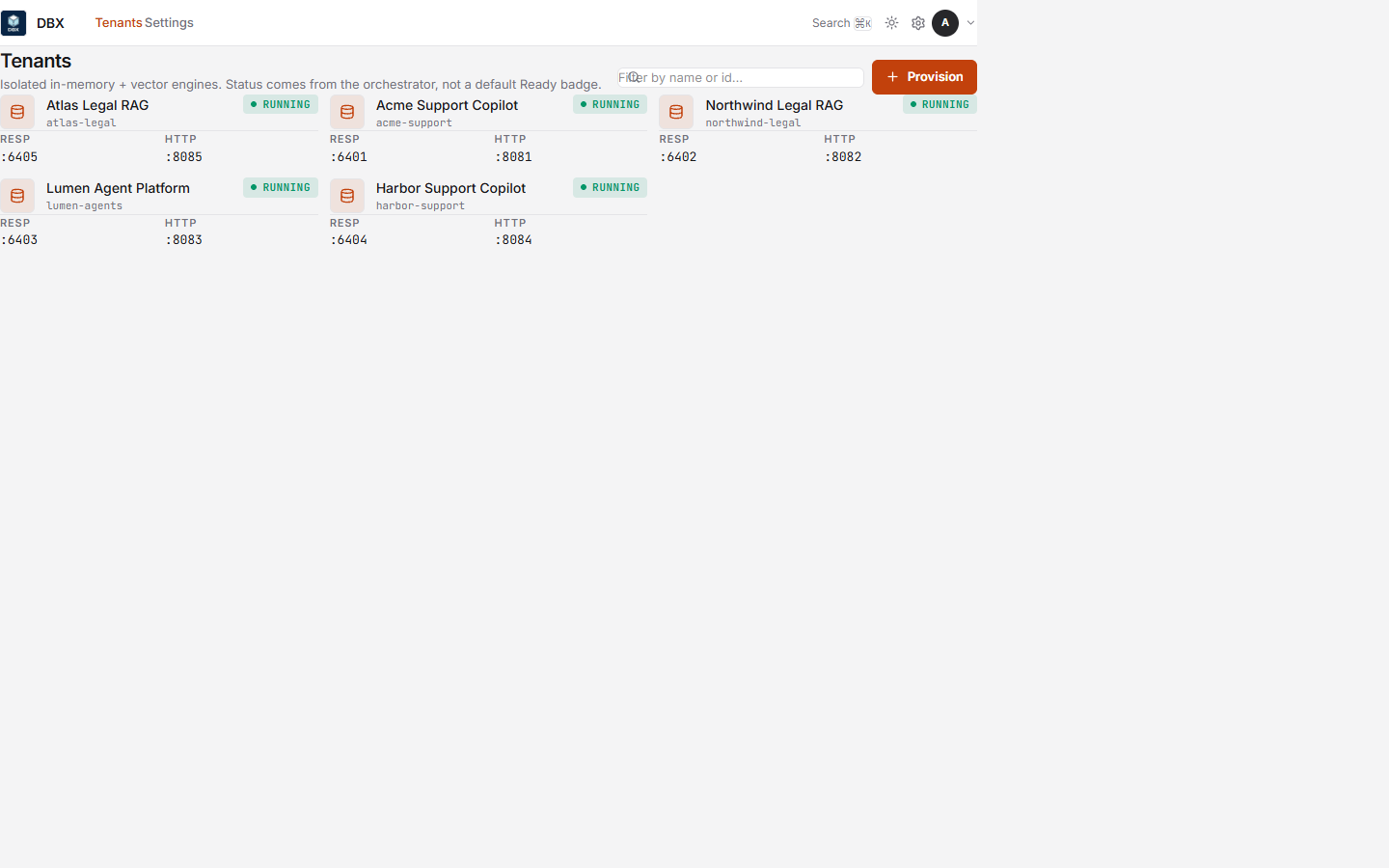
DBX is the per-tenant memory engine for AI products: one isolated store per customer, holding working state and vector memory. Not a shared cluster with a prefix.
 DBX · Incubation deck1
Thesis
Every customer of an AI product needs private session state and private semantic recall. Today that is two systems plus a naming convention. DBX makes the tenant the unit of the database — directory, WAL, HNSW index, process, and key.
KV with TTL: session, scratchpad, rate counters. Same connection as recall.
SQ8 HNSW, mmap’d, sized for per-tenant working sets — not a billion-vector corpus.
Linux strict: process, Landlock, envelope encryption, Unix SO_PEERCRED.
DBX · Incubation deck2Why now
Industry context (order of magnitude, definitions vary): vector databases ~$3.2B in 2025 → ~$8.95B by 2030 (MarketsandMarkets, 27.5% CAGR). Agentic applications of vector DBs ~$0.57B in 2026 → ~$1.73B by 2031 (Mordor Intelligence, 24.86% CAGR).
Firecracker per user is a fleet of computers. Prefix filters are a hope. DBX is the missing third path: kernel-enforced tenant memory at ~14–17 MiB RSS per idle worker.
We do not claim the strongest sandbox. We claim the sealed unit is one customer’s KV plus vectors, with a key you can destroy.
DBX · Incubation deck3Problem
| What teams ship today | What it costs them |
|---|---|
| Tenancy is a key prefix | One forgotten tenant_id is a cross-customer leak |
| Cache + vector DB | Dual writes, drift after crashes, two on-call surfaces |
| Backup is cluster-wide | Cannot restore or export a single customer |
| Deletion is a scan | “Delete my data” becomes an engineering project |
| Shared memory pool | A noisy tenant evicts a quiet tenant’s working set |
| Cost is guessed | No meter for what one customer actually consumes |
None of this is fixed by making the shared cluster faster. It is a consequence of the unit of the database being the cluster.
DBX · Incubation deck4Solution
On-ramp, not a USP: existing RESP clients work. That lowers trial cost. It is not a claim that DBX replaces a tuned Redis cluster.
DBX · Incubation deck5USPs 01–03
POST /api/provision returns a live engine: directory, WAL, HNSW, snapshots, process. Backup, restore, hibernate, and purge operate on exactly one customer.
Session KV and semantic recall share a connection, a directory, and a backup zip. There is no second system to drift from.
Limit: periodic .rdb serializes KV; vectors live in mmap + WAL + seals.
SQ8 rows are ~4× smaller than float32. Idle tenants live in page cache. The metric we want to own is cost per active tenant, not signed-tenant count.
DBX · Incubation deck6USPs 04–05
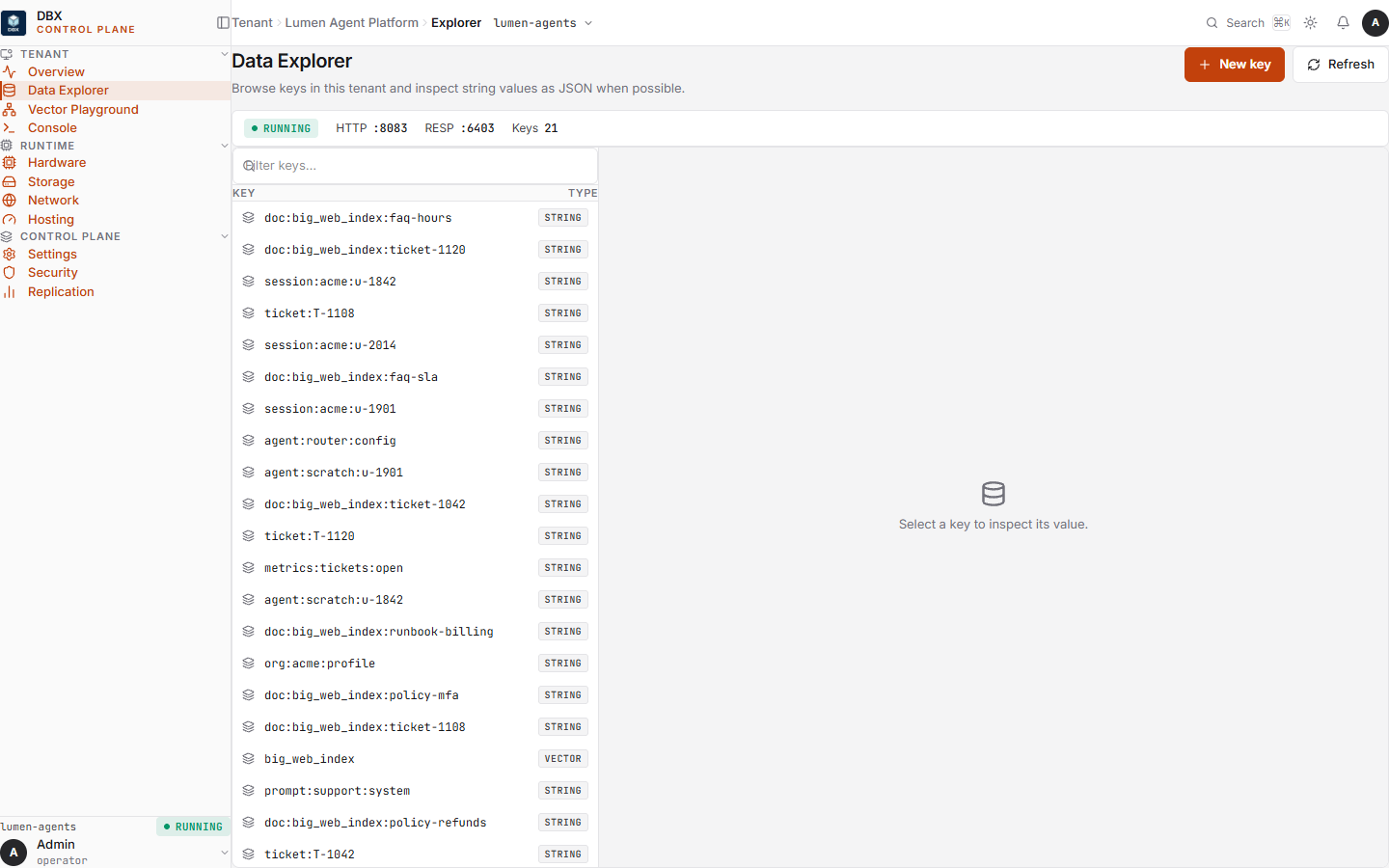
Embeddings never leave the customer’s network. Dashboard, console, explorer, and vector playground compile into the orchestrator. No sidecar. No vendor to send data to.
Linux DBX_ISOLATION_MODE=strict: dedicated dbx-server, Landlock LSM, cgroup v2 (best-effort in containers), AES-256-GCM over WAL / checkpoints / ids / HNSW, Unix sockets that only the orchestrator PID can open.
 DBX · Incubation deck7
Product
Isolated engine in milliseconds. Optional 0–2 async WAL replicas; primary still acks locally.
Reader / writer / tenant-admin. Reader cannot SET or VADD. Secret shown once. Revoke is immediate.
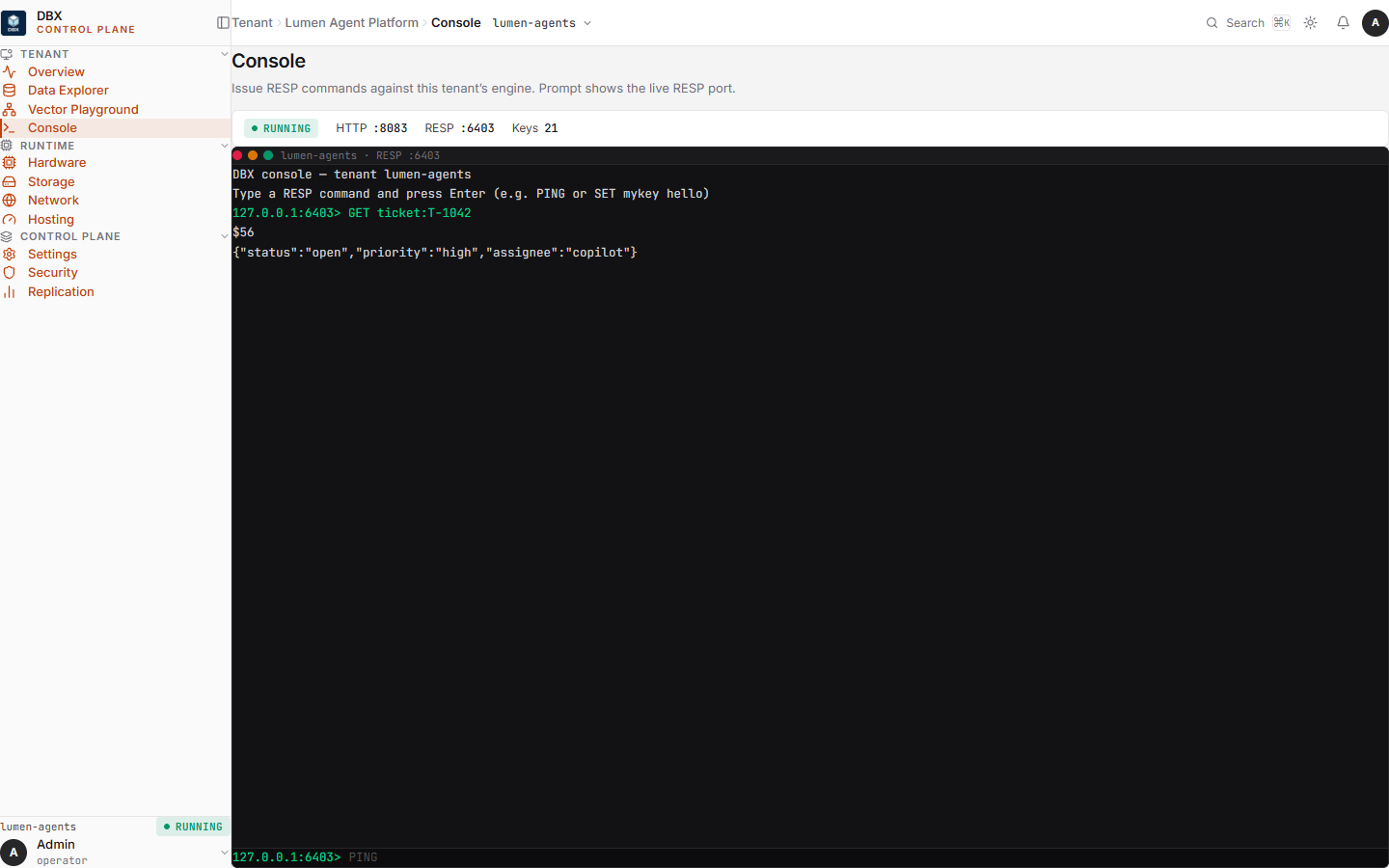
Public data plane is RESP :6380. AUTH tenant:key. Python SDK: remember / recall / forget.
One-customer zip, SHA-256 manifest, restore with rollback. Hibernate stops the process, keeps the dir.
purge=true zeros the wrapped DEK, then deletes the directory. Blast radius: one tenant.
Certified v1 surface: durable strings + vectors. Raft, cluster/sharding, and non-string RESP mutation families fail closed.
DBX · Incubation deck8Who buys
One tenant, one workload. Billion-vector ANN. SQL, joins, or a system of record. A fully managed zero-ops Pinecone-style service as the reason to buy.
DBX sits in front of the system of record and underneath the agent. That is the whole territory.
DBX · Incubation deck9White space
| If you need | Right tool | Why not DBX |
|---|---|---|
| Peak single-instance KV | Redis / Dragonfly | Their design target; our cycles go to isolation |
| Billion-vector ANN + sharding | Qdrant / Milvus | Our indexes are per-tenant working sets |
| Fully managed vectors | Pinecone | We are software you run — deliberately |
| Joins, SQL, system of record | Postgres + pgvector | DBX is memory, not the ledger |
Per-tenant isolation is not a row on those comparison charts. Framed as “Redis alternative,” our best property looks like a quirk. We do not take that fight.
DBX · Incubation deck10Status · v1.1.0
We do not claim ARR, customer logos, SOC 2, a cluster, or a managed cloud. Windows is the certification host; Linux is the production USP. hello@dbxdb.io has no MX yet.
 DBX · Incubation deck11
Proof · one node · one tenant · 27 Aug 2026
Mean 0.920 · p05 0.800 · SQ8 vs float32 brute force. Quantization has a quality cost; we publish it.
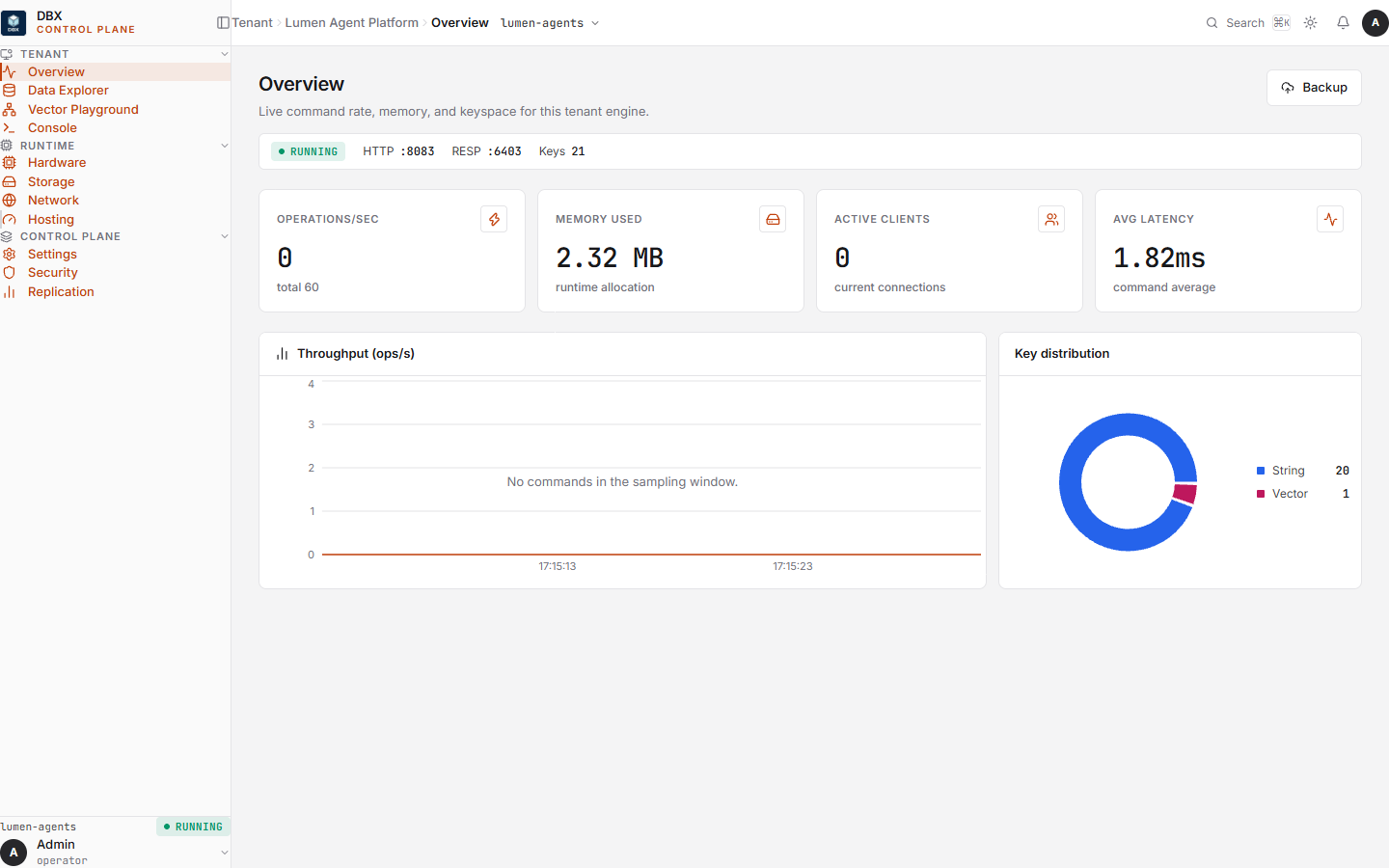
Idle sealed worker ~14–17 MiB RSS. 100 sealed tenants ≈ 1.5 GiB process RSS before corpus. Use inprocess when density is the goal.
Quota rejection isolates OOM. Quiet GET stayed within the isolation harness. Neighbours keep serving.
Not a competitor ranking. Measure on your hardware. Linux CI re-runs the vector harness.
DBX · Incubation deck12Market
Vector DB market ~$3.2B (2025) → ~$8.95B (2030), 27.5% CAGR (MarketsandMarkets). Agent memory infrastructure ~$1.62B now → ~$15.2B by 2034, 28.3% CAGR (HTF).
Agentic AI applications in vector databases ~$0.57B (2026) → ~$1.73B (2031), 24.86% CAGR (Mordor). Self-hosted, per-customer isolation is the slice those reports do not name.
Operational target, not a revenue forecast: 10 vertical-AI SaaS design partners; 3 commercial-license conversations for managed-DBX use. No invented ARR.
Research houses disagree on definitions. We cite ranges as order of magnitude. DBX wins if buyers bill per customer and cannot tolerate prefix tenancy — not if we out-benchmark Redis.
DBX · Incubation deck13Business model
Production, personal, or commercial. Embed inside your own SaaS — each of your customers is a tenant. Converts to Apache 2.0 after four years.
Required if DBX itself is the service you sell to third parties. Not a gray area in the additional use grant. The billable unit is the tenant.
Named contacts, SLA language for procurement. No fake monthly tiers on the website. Price follows workload shape.
Why this converts: the people we most want using DBX are companies embedding it. The license permits that. Cash arrives when someone wants to offer DBX as infrastructure — or when we elect to run the managed service the BSL reserved for us.
DBX · Incubation deck14Go-to-market · 18 months
DBX · Incubation deck15The ask
We are raising an 18-month operating partnership — not a priced round invented for this slide. The envelope scales; the mix does not.
Density beyond 100/node, replica promote, engine coverage, optional float32 accuracy mode.
Register dbxdb.io + MX, commercial license paper, SOC 2 readiness program, LUKS operator path.
10 design partners · 3 commercial conversations · Linux density published · mailbox live.
DBX · Incubation deck16Team
Engineering undergraduate, Delhi Technological University. Designed and shipped DBX: Go 1.25 engine, Isolation Kernel (Landlock, envelope encryption, SO_PEERCRED), SQ8 HNSW, orchestrator, dashboard, Python SDK, and the public site.
Public identity: github.com/vanshjain-0702 · License: DBX Authors
DBX · Incubation deck17Risks we already name
.vec rows stay mmap’d and unencrypted so idle tenants stay cheap — use LUKS/fscrypt.connect() or stat(). Sockets are SO_PEERCRED + mode 0600.DBX · Incubation deck18
Close
We are asking incubation to take a shipped Isolation Kernel to the first ten design partners and the first commercial licenses — with the same honesty we use in the code.
 DBX · Incubation deck · v1.1.0 · September 202619
Appendix · Non-goals
| Off the roadmap | Why |
|---|---|
| Beating Redis on single-instance KV | Wrong buyer, unwinnable axis |
| Sharded billion-vector ANN | Wrong index size for our thesis |
| Managed DBX cloud as a default | BSL exists so this stays a company decision |
| SQL / joins / cross-entity ACID | We are memory, not the system of record |
| OLAP over history | Wrong shape entirely |
Source of truth: docs/positioning.md · Isolation Kernel: docs/isolation.md · License: LICENSE (BSL 1.1 → Apache 2.0 after four years).
DBX · Incubation deck20